


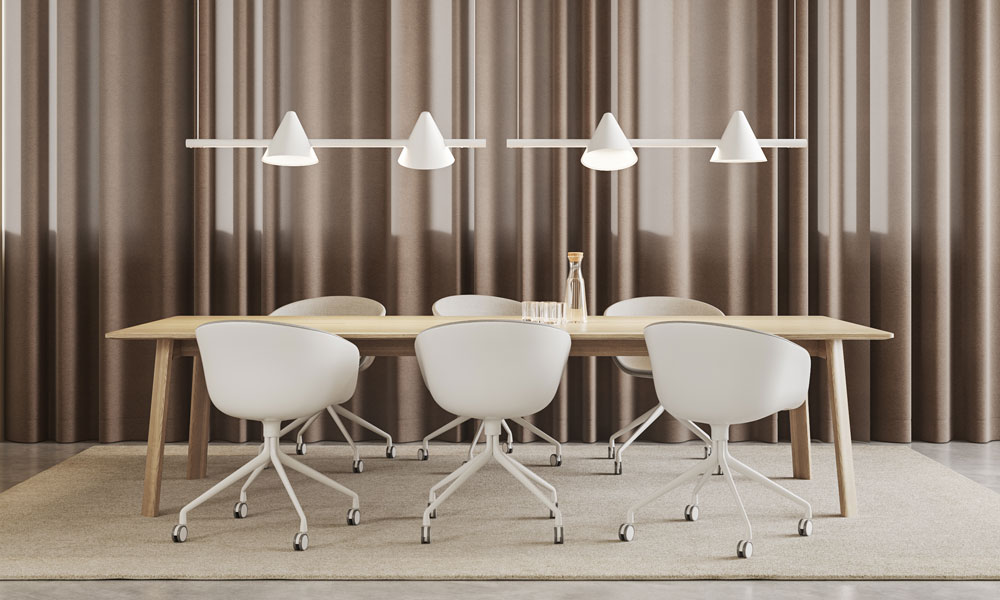
Suspending linear luminaires
Linear luminaires are one of the most common formats in office, retail and hospitality lighting, and the format where suspension is least forgiving. A two-metre fixture hanging from two wires shows every millimetre of error, and a row of ten fixtures shows it ten times over.
Why linear luminaires are harder to suspend than round ones
A pendant with a single suspension point hangs level by itself. A linear fixture cannot. It needs at least two points, and from that moment three things start working against you:
The fixture has to hang level along its length. Any difference in the two wire lengths tilts the whole fixture, and the longer the fixture the more visible the tilt.
The weight is rarely evenly distributed. Drivers, connection boxes and end caps sit at one end or the other, so the load on the two wires is not equal even when the fixture looks symmetrical.
Rows have to align with each other. Ten fixtures at slightly different heights read as a mistake even when each one is individually level.
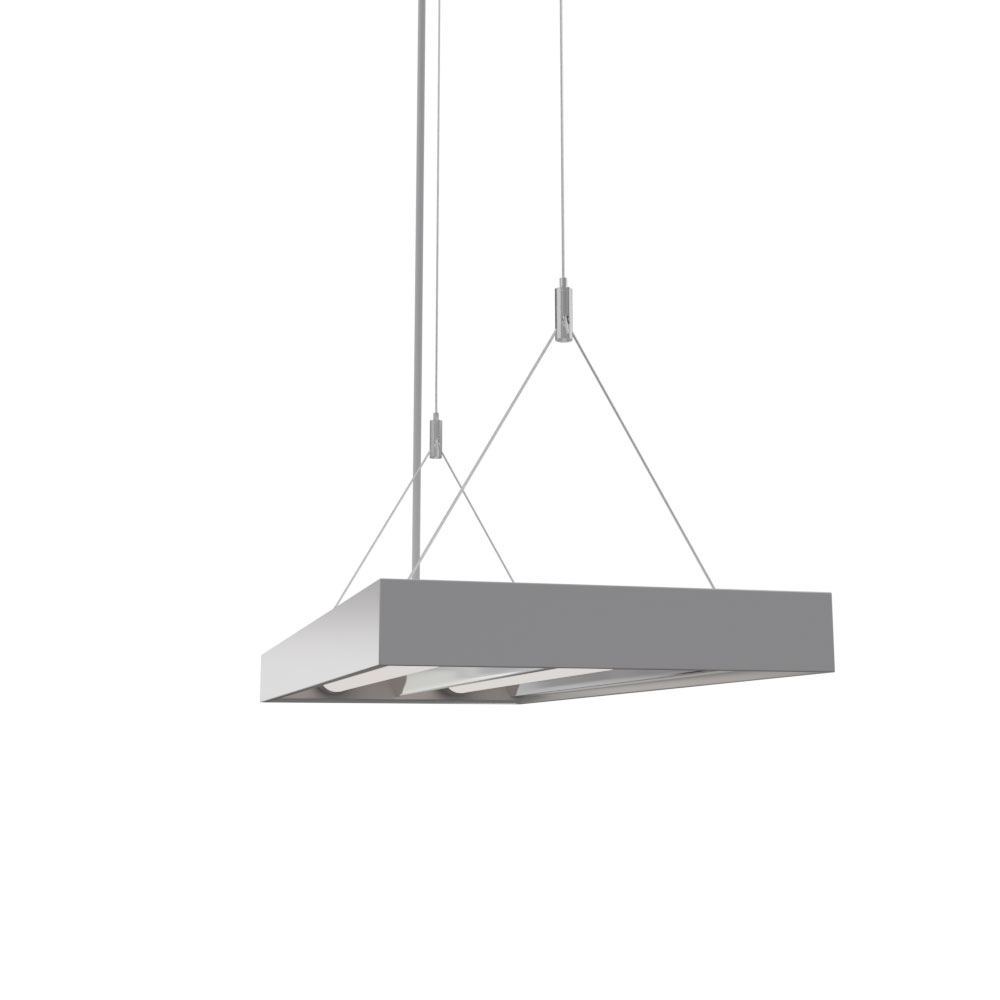
A multipoint gripper with tool-free height adjustment solves all three. A gripper lets the installer set each wire independently, sight down the row, and correct without taking anything down. The multipoint function makes two ceiling fixings feed four connection points on the fixture, so the fixture is supported at four places along its length while the installer only has two wires to adjust. Uneven weight distribution evens out through the arrangement, the fixture sits level along its length, and setting the height means adjusting two grippers rather than four.
How many suspension points
| Fixture length | Suspension points |
| Up to 1.2 m | 2 |
| 1.2 to 2.5 m | 2, or 3 where the housing is not rigid |
| Over 2.5 m | 3 or more |
| Continuous runs | One point at each joint, shared between the two fixtures, plus one at each end of the run |
Two points are the standard arrangement. Add a third when the housing flexes under its own weight, when the fixture is long enough for the middle to sag visibly, or when the load is concentrated at one end.
A four-point suspension does not divide the load by four. Small differences in wire length and ceiling flatness mean the load distributes unevenly across the four wires, and how unevenly depends on the fixture’s rigidity and where its weight sits. Follow the fixture manufacturer’s guidance for load distribution, and contact us if you need help checking the wire selection.
Selecting the wire
Linear luminaires are usually light. Most fall between 2 and 8 kg per meter, so Ø1.0 mm or Ø1.2 mm wire covers the majority of installations. Thinner wire is generally preferred in architectural lighting because it is close to invisible at a distance.
Calculate the load per wire, not the total fixture weight, and check it against the working load limit for that diameter. Where the fixture hangs at an angle rather than vertically, the tension in each wire is higher than the weight it carries.
Selecting the gripper
Three arrangements are available for a linear luminaire, and the choice affects appearance, load distribution and how much work the installer has on site.
Multipoint gripper
Two ceiling fixings feed four connection points on the fixture. The fixture is supported at four places along its length while the installer adjusts only two grippers, and uneven weight distribution evens out through the arrangement. The wire exits from the side, so the gripper cannot be concealed inside the housing.
Side exit gripper, mounted to the fixture
One gripper per suspension point, with the wire leaving from the side. The choice where there is no room for the wire inside the housing. Turning the gripper sets the direction the wire exits. Set the height first, then either cut the wire or let it rest on top of the fixture so the height can be lowered again later.

Bottom exit gripper, mounted to the fixture
One gripper per suspension point, concealed inside the housing for the cleanest appearance. The housing has to be designed for it: the wire end moves inside the fixture during adjustment, so it must not be able to reach the driver, the wiring or the PCB, and there has to be a clear path for the wire or the height will be hard to adjust.

Cable management
The supply cable should not carry any of the fixture’s weight. Route it alongside one of the suspension wires and clip it with for example product 45101560, so the wire takes the load and the cable stays tidy and vertical. A canopy at the ceiling covers the fixing and the cable entry.
Components for linear luminaire suspension
- Wire grippers — tool-free wire height adjustment
- Steel wire — 7×7 stainless, cut to length with the ending you specify
- Attachments — flat, angled and grid ceiling fixings, and canopies
- Complete kits — assembled, cut to length and packed for installation
Specifying a linear luminaire? Send us the fixture weight, length, number of suspension points, drop length and how the wire connects to the housing. We will come back with a specification. Contact our technical team.