


Suspending lighting track and rail
Track lighting is usually installed surface-mounted or recessed, but suspended track solves problems neither of those can: high ceilings, exposed services, attachment options for any ceiling, and retail spaces where the lighting layout changes with the merchandising.
When suspended track makes sense
High or unreachable ceilings. Bringing the track down to a working height puts the light where it is needed and makes reaiming and relamping possible without a lift.
Exposed or serviced ceilings. Where there is no ceiling surface to mount to, or where ductwork and services sit above, suspension is often the only route.
Layouts that change. Retail, galleries and showrooms reconfigure regularly. A suspended track can be repositioned without repairing a ceiling.
Heritage and protected buildings. A few ceiling fixings carry several metres of track and every fitting on it, and the installation can be removed later without leaving a repair.
Sizing for a loaded track
Track is heavier per metre than most luminaires, and the load is not fixed. Every spotlight added changes both the total weight and where it sits, and fittings get moved during the life of the installation.
That has three consequences for the suspension:
Size for the loaded track, not the empty track. Include the weight of every fitting the track will carry, and allow for more being added later.
Use more suspension points. Track manufacturers specify a maximum spacing between supports, typically between 1 and 2 meters depending on the profile. Follow their figure, not a general rule.
Expect the load to move. A spotlight repositioned to one end changes the distribution across the wires. Adjustable grippers let the installation be re-levelled rather than re-built.
Suspension points and spacing
| Guidance | |
| Support spacing | As specified by the track manufacturer, typically 1-2 m |
| Minimum per length | 2 points, plus a point at every joint |
| Overhanging ends | Keep the length beyond the last suspension point short, or add a support |
| Fully loaded weight | Track weight, plus all fittings, plus allowance for additions |
Fixing to the track profile
Most track profiles accept suspension through one of three ways:
Keyhole slots or punched holes – take a gripper used for track and rail or a T-shaped ending that locates into the slot.
Threaded bosses or M-thread fixings – use a male or female threaded gripper connection.
Aluminium profile channels – take a purpose-made bracket sized to the channel.
Confirm how to connect the suspension system to the track against the track manufacturer’s data before specifying. Profiles differ between systems, and a fixing that suits one make will not necessarily suit another.
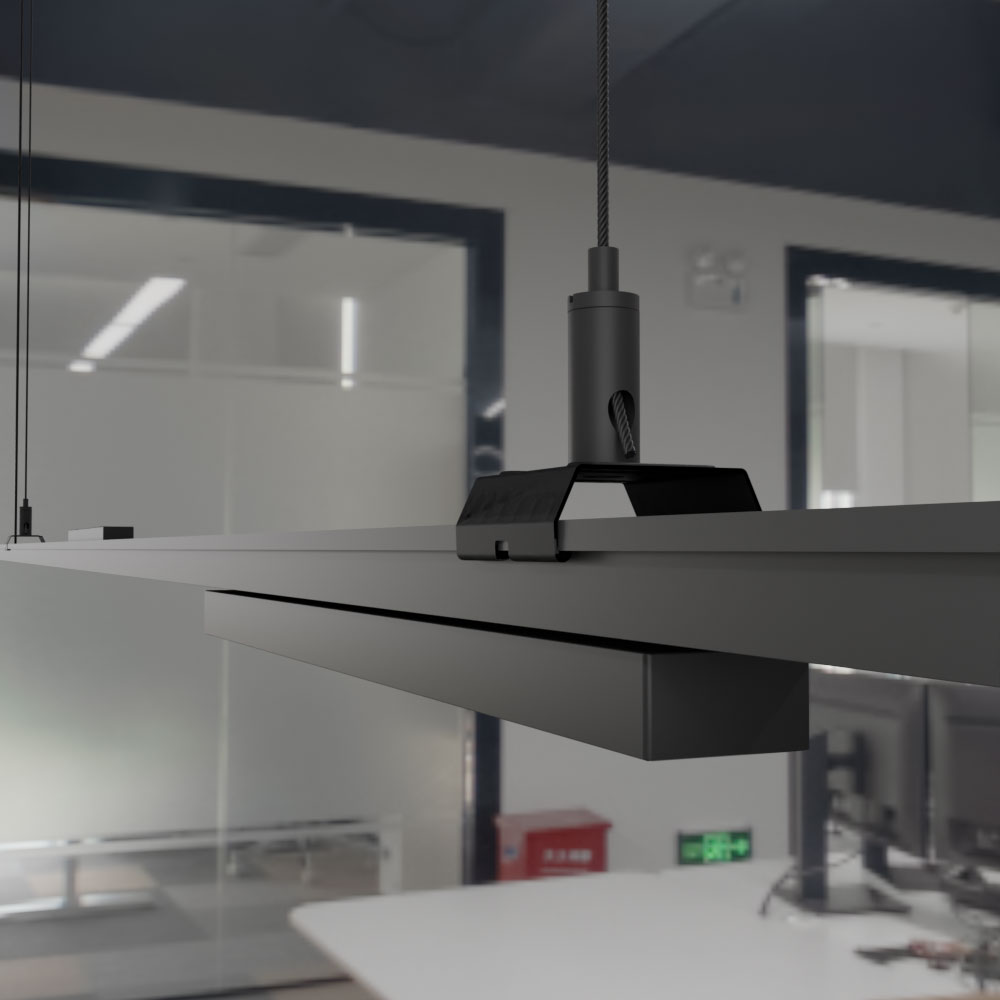
Levelling a suspended track run
A track run has to be level along its length and consistent in height across parallel runs, and it is usually installed by someone working overhead on a platform. Tool-free adjustment matters more here than almost anywhere else: every wire can be adjusted in place, as many times as needed, without taking the run down.
Check the load at every stage, including during installation. Working from the ends means the first two wires can carry most or all the run before all suspension points are set. On a short run within the working load limit that is fine. On a longer or heavier run it is not: the load must stay within the limit at every point in the sequence, not only when the installation is finished. A brief overload still counts – a gripper or wire loaded beyond its limit can deform, and a deformed assembly does not recover its rated performance even once the load comes off.
Where the run is too heavy to be carried on two points, hang all points loosely and level them afterwards. See our weight guidelines for the working load limits.
Kits supplied with the track
A suspension kit contains everything for one point: wire, gripper, ceiling attachment and the fixing to the track profile, cut to your drop length and packed ready to install.
Track manufacturers can include one kit per meter of track supplied, so the installer opens one box and has the suspension already matched to the profile. Nothing to specify separately, nothing to order late, and no risk of a fixing that does not suit the track.
Every kit is built to a specific track. Send us the profile, weight, the drop length and how the wire connects, and we will go through the options with you – contact us to put together your own kit.

Components for track and rail suspension
- Wire grippers — tool-free adjustment, with threads, hook or slit connections
- Steel wire — 7×7 stainless, with loop, eyelet or T-shaped endings for slots and threads
- Brackets — a connection point to fix a gripper or a wire to the track profile
- Attachments — ceiling fixings for flat, angled and grid ceilings
Working load limits depend on the wire diameter and the gripper together – see weight guidelines for the figures.
Suspending a track system? Send us the track profile, the loaded weight per metre, the run length and the drop, and we will specify the assembly. Contact our technical team.